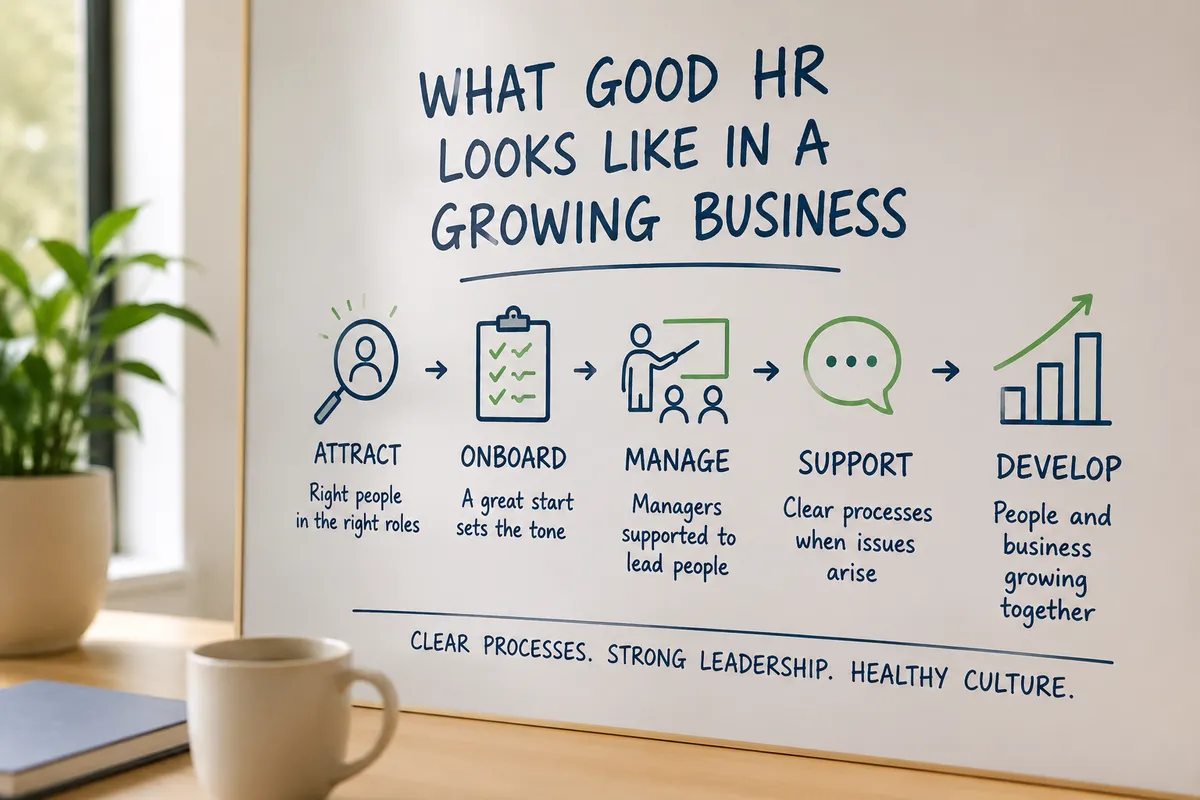
What Good HR Looks Like in a Growing Business
Good HR is not a collection of policies sitting in a folder.
It is not an employment contract that gets signed when someone starts, followed by a reminder to update it again when something changes. And it is not simply having someone to call when a difficult employee situation arises.
Good HR is the combination of practical systems, clear expectations and capable people that helps a business manage its workforce consistently.
That becomes increasingly important as a business grows. What worked when there were five employees may not be enough when there are twenty or thirty. More people means more managers, more decisions, more potential for inconsistency and less ability for the business owner to know everything that is happening.
The question is not whether your business has HR. The question is whether the HR systems you have are actually supporting the business and its people.
It starts before someone joins the business
Good HR starts before an employee's first day.
The business should have a clear understanding of what the role involves, what skills and experience are required and what will be expected of the person who takes it on. A clear position description can help set those expectations before recruitment even begins.
Once someone is hired, there should also be a consistent process for getting them started. This includes the required employment information and documentation, but also the practical things that help a new employee understand their role, their responsibilities and how the business operates.
When onboarding is left to whoever happens to have time on the day, important information can easily be missed. A consistent process makes it easier for managers to know what needs to happen and gives new employees a more reliable start.
Managers need to know how to manage people
As a business grows, more responsibility for employees is often placed in the hands of managers.
That can create a problem if managers are expected to deal with people issues without the right support. Being good at the technical or operational side of a role does not automatically mean someone knows how to manage performance, handle conflict or respond to an employee complaint.
Managers do not need to be HR experts. They do need to understand what is expected of them, know how to approach common people issues and recognise when something needs to be escalated.
Good HR gives managers a framework to work within. It helps them deal with issues earlier and more consistently, rather than leaving them to work everything out themselves.
Performance should not be an annual conversation
Performance management is often treated as something that happens during an annual review.
In reality, good performance management is ongoing.
Employees need to understand what is expected of them, receive feedback on how they are performing and have an opportunity to address concerns when they arise. Managers also need to feel confident having those conversations rather than waiting until a problem has become too difficult to ignore.
A formal performance process may be appropriate in some circumstances, but not every performance conversation needs to begin there. Clear expectations, timely feedback and appropriate follow-up can often prevent smaller concerns from becoming more significant issues.
The important thing is that performance is managed consistently rather than only being addressed when something goes wrong.
Employees need to know what happens when something goes wrong
No business is going to have a completely problem-free workforce.
Employees will raise concerns. Conflicts will happen. People will disagree. There will be performance issues, absences and situations that require a manager to make a decision.
Good HR does not prevent all of these things from happening.
Instead, it gives the business a sensible way to respond.
Managers should know what to do when an employee raises a concern and, just as importantly, what they should not do. Employees should understand where they can raise an issue and have confidence that it will be handled appropriately.
Having a clear process does not guarantee that every situation will be straightforward. It does, however, mean the business is not starting from scratch every time something happens.
HR systems need to grow with the business
The HR systems that worked for a small team may not continue to work as the business grows.
When everyone knows each other and the business owner is involved in most decisions, informal processes can be enough. As the team becomes larger, that becomes much harder to maintain.
Different managers may start handling similar situations differently. New employees may receive different onboarding experiences. Important information may be stored in different places, and the business may become increasingly reliant on individual people remembering what needs to happen.
This is often the point where businesses need to move from informal HR practices to clearer, more consistent systems.
That does not mean creating unnecessary bureaucracy. It means putting enough structure around the employee journey to make sure important things happen consistently, regardless of who is managing them.
Good HR should make the business easier to manage
The purpose of HR systems should not be to create more work for managers or business owners.
Good HR should provide clarity.
Managers should know what is expected of them. Employees should understand what is expected of them. The business should have a consistent approach to common situations, and everyone should know when additional HR support is needed.
When those foundations are in place, HR becomes less reactive. Managers can deal with issues earlier, employees have clearer expectations and the business is better prepared when something unexpected happens.
That is ultimately what good HR should do. It should support the business rather than becoming another problem for the business to manage.
How healthy are your HR foundations?
If you are not sure whether your current HR systems are keeping up with your business, the Halcyon HR Health Audit can give you a useful starting point.
The free five-minute audit looks at three areas of your HR foundations: Compliance, Process and Leadership. It provides a personalised HR Health Score, along with areas that may be worth addressing and recommended next steps based on your responses.
The purpose is not to suggest that every business needs a complicated HR system. It is to help you understand where your current foundations are strong, where there may be gaps and what may deserve your attention first.
→ Click this link to take the free Halcyon HR Health Audit
If you have already completed the audit and would like to talk through your results, you can also book a free discovery call with the Halcyon HR team here.
Good HR does not need to be complicated. It needs to be practical, consistent and strong enough to support the people and the business as they grow.