Reactive HR vs Proactive HR: What's the Difference?
If HR only gets your attention when something goes wrong, your business is operating reactively.
That is not necessarily a criticism. For many small and growing businesses, HR starts as something the owner manages alongside everything else. When the team is small, everyone knows each other, decisions can be made quickly and most issues can be dealt with through a conversation.
As the business grows, however, that approach becomes harder to maintain. More employees means more situations to manage, more managers become involved in people decisions and there is less opportunity for the business owner to be across everything that is happening.
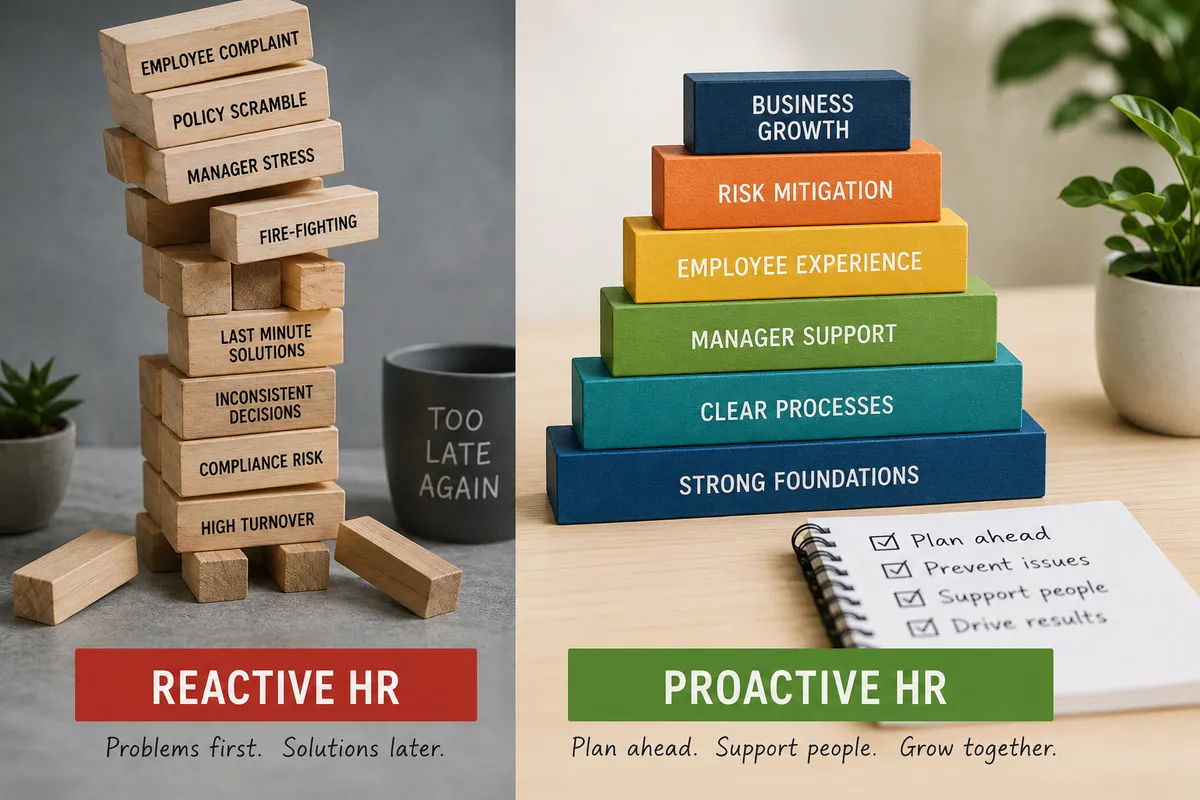
This is where the difference between reactive and proactive HR becomes important. The goal is not to predict every problem that might occur. It is to have sensible systems and processes in place so that the business is better prepared when people issues arise.
What does reactive HR look like?
Reactive HR is generally driven by an event.
An employee raises a complaint, so the business starts looking for a process to follow. A manager has a performance concern, so they ask what they should do. A new employee is starting next Monday, so someone begins putting together an onboarding process. A policy is needed because a particular situation has arisen, so a policy is created.
There is nothing inherently wrong with responding to problems when they occur. Some issues cannot be anticipated, and every business will have situations that require a response.
The problem is when this becomes the normal way HR is managed. When every issue is dealt with from scratch, there is a greater risk of inconsistent decisions, missed steps and managers being unsure about what they should do. It can also mean that HR takes up significantly more time and attention than it needs to.
What does proactive HR look like?
Proactive HR is about putting the foundations in place before they are needed.
That might mean having a clear onboarding process before the next employee starts, making sure managers understand how to address performance concerns, reviewing employment documentation regularly and ensuring policies reflect the way the business actually operates.
It also means thinking about the employee journey rather than looking at each HR issue in isolation. Recruitment, onboarding, performance management, development and employee concerns are all connected, and the systems supporting them should work together.
Proactive HR does not mean creating a process for every possible scenario. It means identifying the areas where your business is most likely to need structure and making sure there is a sensible approach in place.
Why does the difference matter as a business grows?
The informal approach that works well in a small business can become difficult to manage as the team grows.
When there are only a handful of employees, the business owner may know what is happening with everyone. A manager can raise an issue directly and decisions can often be made quickly.
As the business grows, that becomes more difficult. There may be several managers making people decisions, employees working across different teams and new people joining regularly. Without clear processes, similar situations can start being handled differently.
This is not necessarily because anyone is doing the wrong thing. It is often simply a sign that the business has reached a point where its HR systems need to become more structured.
The earlier those systems are established, the easier it is to maintain consistency as the business continues to grow.
Proactive HR is not about more paperwork
One of the common misconceptions about proactive HR is that it means creating more policies, forms and procedures.
That is not the objective.
A process that nobody understands or uses is not particularly useful, regardless of how comprehensive the document may be.
Good HR systems should make things clearer, not more complicated. Managers should know what is expected of them, employees should understand the processes that affect them and the business should have a consistent way of dealing with common situations.
Sometimes that may involve a formal policy or documented process. Other times, it may simply mean giving managers clear guidance and making sure everyone understands how something should be handled.
The focus should be on what the business actually needs, rather than creating HR documentation for its own sake.
Where should you start?
Moving from reactive to proactive HR does not require you to change everything at once.
Start by looking at the situations that repeatedly take up time or create uncertainty in the business. Are managers regularly asking how to handle performance issues? Do new employees receive a different onboarding experience depending on who is managing them? Are you unsure whether your employment documentation and policies are still current? Do employee concerns tend to be dealt with differently from one situation to the next?
These can be useful indicators of where your HR foundations may need attention.
The priority will be different for every business. What matters is understanding where the gaps are and deciding which ones need to be addressed first.
How healthy are your HR foundations?
If you are not sure whether your business is operating reactively or has the foundations for a more proactive approach, the Halcyon HR Health Audit can give you a useful starting point.
The free five-minute audit looks at three areas of your HR foundations: Compliance, Process and Leadership. It provides a personalised HR Health Score, along with areas that may be worth addressing and recommended next steps based on your responses.
The purpose is not to tell you that everything needs to change. It is to help you understand where your HR foundations currently stand and where your attention may be best placed.
→ Click this link to take the free Halcyon HR Health Audit
If you have already completed the audit and would like help working through your results, you can also book a free discovery call with the Halcyon HR team here.
Good HR is not about waiting for the next problem and hoping you will know what to do when it arrives. It is about putting the right foundations in place so that when something does happen, your business is ready to respond.