NSW Workers Compensation Reforms: What the New Psychological Injury Thresholds Mean for Employers
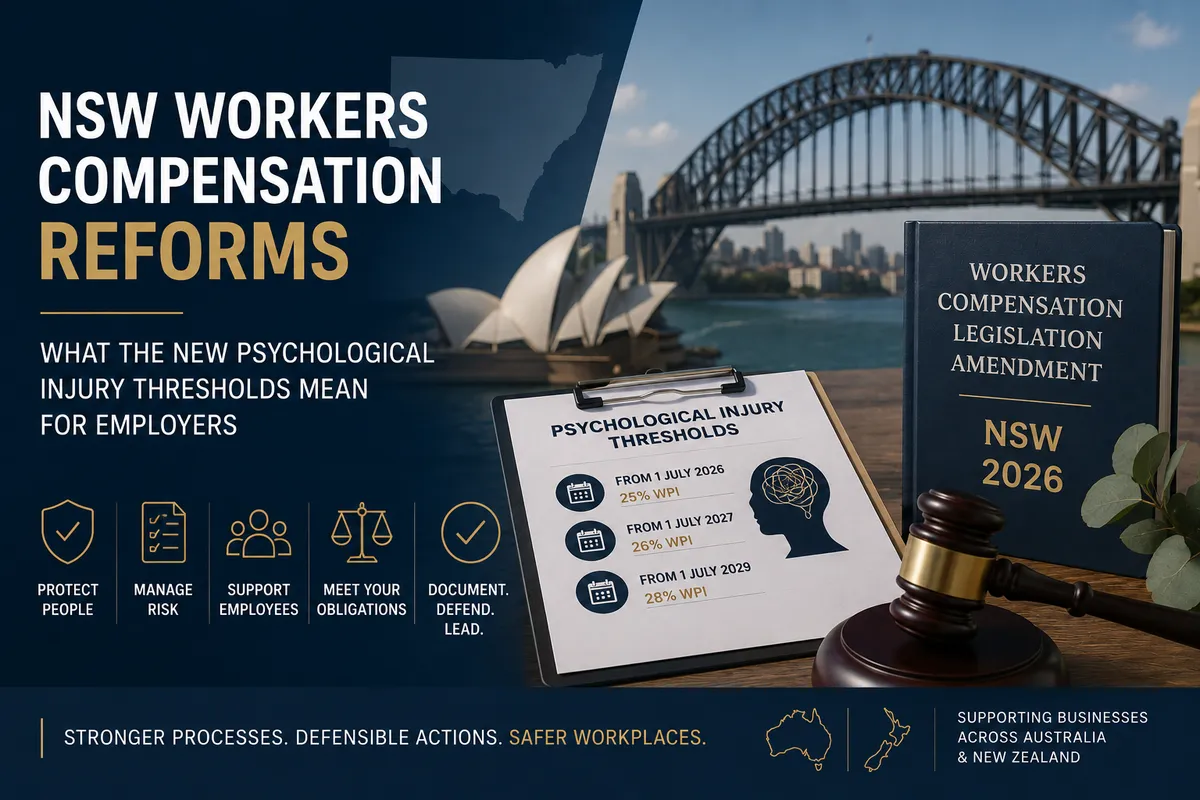
From 1 July 2026, a worker in New South Wales needs a whole person impairment rating of at least 25 percent before they can access lump sum damages for a psychological injury, up from 15 percent only months earlier.
The Workers Compensation Legislation Amendment (Reform and Modernisation) Bill 2026 (NSW) lifts the WPI threshold in three stages, to 26 percent by July 2027 and 28 percent by July 2029. Weekly payments for primary psychological injuries are now capped at 130 weeks, roughly two and a half years, unless that same 21 percent WPI benchmark is met. Alongside this, the Workers Compensation Legislation Amendment Bill 2025 (NSW) narrows what counts as a compensable psychological injury at all. A claim must now arise from a defined relevant event, meaning violence, indictable criminal conduct, a witnessed traumatic incident, vicarious trauma, harassment, bullying, or excessive work demands. General stress, burnout, or a vaguely toxic culture no longer qualifies on its own.
The new legislation also formalises a defence employers have relied on informally for years. Reasonable management action, including performance feedback, disciplinary process, and legitimate investigation of misconduct, is now expressly excluded from giving rise to a compensable injury, provided it is carried out reasonably. That protection only holds if a business can show its process was reasonable, which means documentation, not memory, is what a claim will turn on.
None of this reduces the underlying duty. A narrower compensation pathway does not touch the primary duty of care under work health and safety law, and a worker who cannot meet the new WPI threshold can still pursue a negligence claim if a psychosocial hazard was left unmanaged. In New Zealand, the Health and Safety at Work Act 2015 imposes the same broad primary duty regardless of how ACC caps are structured, so a PCBU on either side of the Tasman carries the exposure either way.
Halcyon HR Consultancy helps Australian and New Zealand businesses build the documented, defensible management action records that these reforms now demand, so a claim turns on evidence rather than assumption. Kyall Thompson works directly with employers to close that gap before a claim, not during one.
Reach out at https://halcyonhr.com.au/