5 HR Risks Small Businesses Shouldn't Wait Until There's a Problem to Address
Most HR problems are easier to deal with before they become urgent.
That can be difficult to remember when you're running a small or growing business. There are always competing priorities, and if the team is working well and there are no obvious employee issues, HR can quite reasonably move down the list.
The problem is that some HR risks remain largely invisible until something happens that exposes them. A manager needs to deal with a performance issue, an employee raises a complaint, someone questions their employment conditions or a new employee starts before the business has properly prepared for them.
By that point, the business is no longer simply looking at whether its HR systems could be improved. It is trying to respond to a situation that may already require attention.
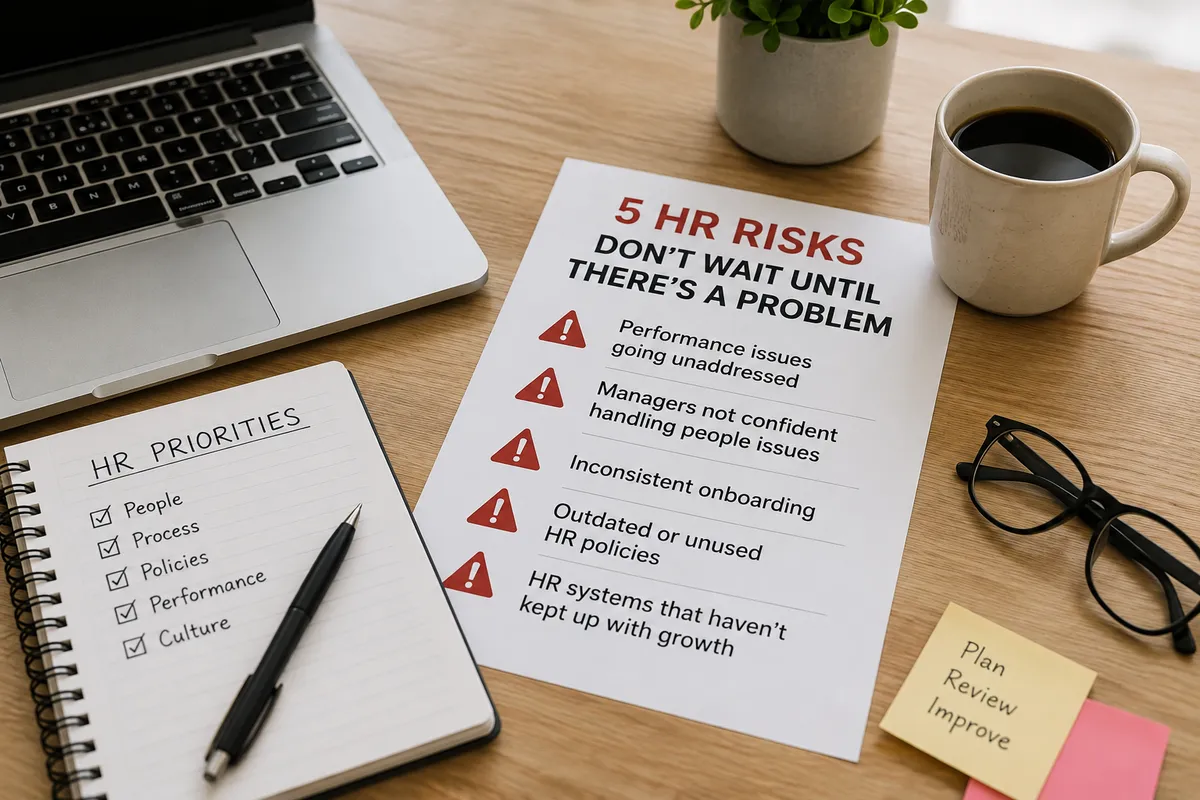
Here are five areas that are worth looking at before they become a bigger problem.
1. Performance issues that are not being addressed
Performance concerns rarely become easier because they have been left alone.
A manager may notice that an employee is not meeting expectations but decide to give them more time. The conversation gets postponed because there are other priorities, or because the manager is not sure how to approach it. Eventually, the issue has continued for long enough that it becomes more difficult to determine what has been communicated and what opportunities the employee has been given to improve.
Addressing performance concerns early does not mean immediately starting a formal process. In many cases, a clear conversation about expectations, appropriate feedback and follow-up may be enough to address a concern before it develops further.
The important thing is that managers are confident enough to have those conversations and that the business has a consistent approach to managing performance.
2. Managers who are not confident handling people issues
Managers are often promoted because they are good at their jobs. That does not necessarily mean they have been given the skills or support they need to manage people.
A manager may be comfortable managing workloads and meeting operational targets but feel much less confident when an employee raises a complaint, two employees are in conflict or someone's performance begins to decline.
Without appropriate guidance, managers may avoid difficult conversations, handle similar situations differently or try to resolve issues without recognising when HR support is needed. That can create additional risk for the business and make problems more difficult to manage.
Managers do not need to become HR professionals. They do need to understand their responsibilities, have clear processes to follow and know when an issue needs to be escalated.
3. Inconsistent onboarding
The way a new employee starts can have a lasting impact on their understanding of the role and the business.
If onboarding is structured and consistent, new employees receive the information they need, understand what is expected of them and know where to go when they have questions. If onboarding depends on who happens to be available on the day, important information can easily be missed.
This becomes more difficult as a business grows. What was manageable when one person was responsible for welcoming every new employee may not work when several managers are recruiting and onboarding people at different times.
A documented onboarding process helps make sure the important steps happen consistently. It also reduces the risk of relying on someone's memory to remember what needs to be covered each time a new employee starts.
4. Outdated or unused HR policies
Having HR policies is important, but having policies that are outdated or disconnected from the way the business operates can create their own problems.
A policy may have been written several years ago when the business looked very different. The team may have grown, working arrangements may have changed and responsibilities may have moved between managers, but the policy has remained untouched.
There is also a difference between having a policy and having a process that people actually understand and use. Managers need to know how policies apply in practice, and employees need to know where they can find the information that affects them.
Regularly reviewing your HR documentation helps ensure that what is written down still reflects how the business operates and the obligations that apply to it.
5. HR systems that have not kept pace with business growth
Growth can expose weaknesses that were not obvious when the business was smaller.
When there are only a few employees, the business owner may know what is happening with everyone and managers can often resolve issues informally. As the team grows, that becomes harder. More people are involved in decisions, more employees need to be managed and there is greater potential for different approaches to develop across the business.
This can result in inconsistent onboarding, different approaches to performance management or uncertainty about who is responsible for handling particular employee issues.
The business has not necessarily done anything wrong. It has simply reached a point where the systems that worked previously may no longer be enough.
That is often a good time to review the way HR is being managed and identify where additional structure would make the business more consistent and easier to manage.
You do not need to fix everything at once
Finding an HR gap does not mean you suddenly have a long list of problems that all need to be addressed immediately.
The more useful approach is to understand which areas represent the greatest risk or are having the biggest impact on your business and people. A compliance issue may need immediate attention, while an inefficient process may be something that can be improved over time.
The priorities will be different for every business.
What matters is knowing where the gaps are and having enough information to decide what should come first.
How healthy are your HR foundations?
If you are not sure where your business currently stands, the Halcyon HR Health Audit can provide a useful starting point.
The free five-minute audit looks at three areas of your HR foundations: Compliance, Process and Leadership. You will receive a personalised HR Health Score, along with areas that may be worth addressing and recommended next steps based on your responses.
The purpose is not to give you another list of things to worry about. It is to help you identify where your HR foundations are strong, where there may be gaps and what deserves your attention first.
→ Click this link to take the free Halcyon HR Health Audit
If you have already completed the audit and would like to talk through your results, you can also book a free discovery call with the Halcyon HR team here.
You do not have to wait for an HR problem to become urgent before doing something about it. In many cases, the best time to strengthen your HR foundations is while things are still working well.